
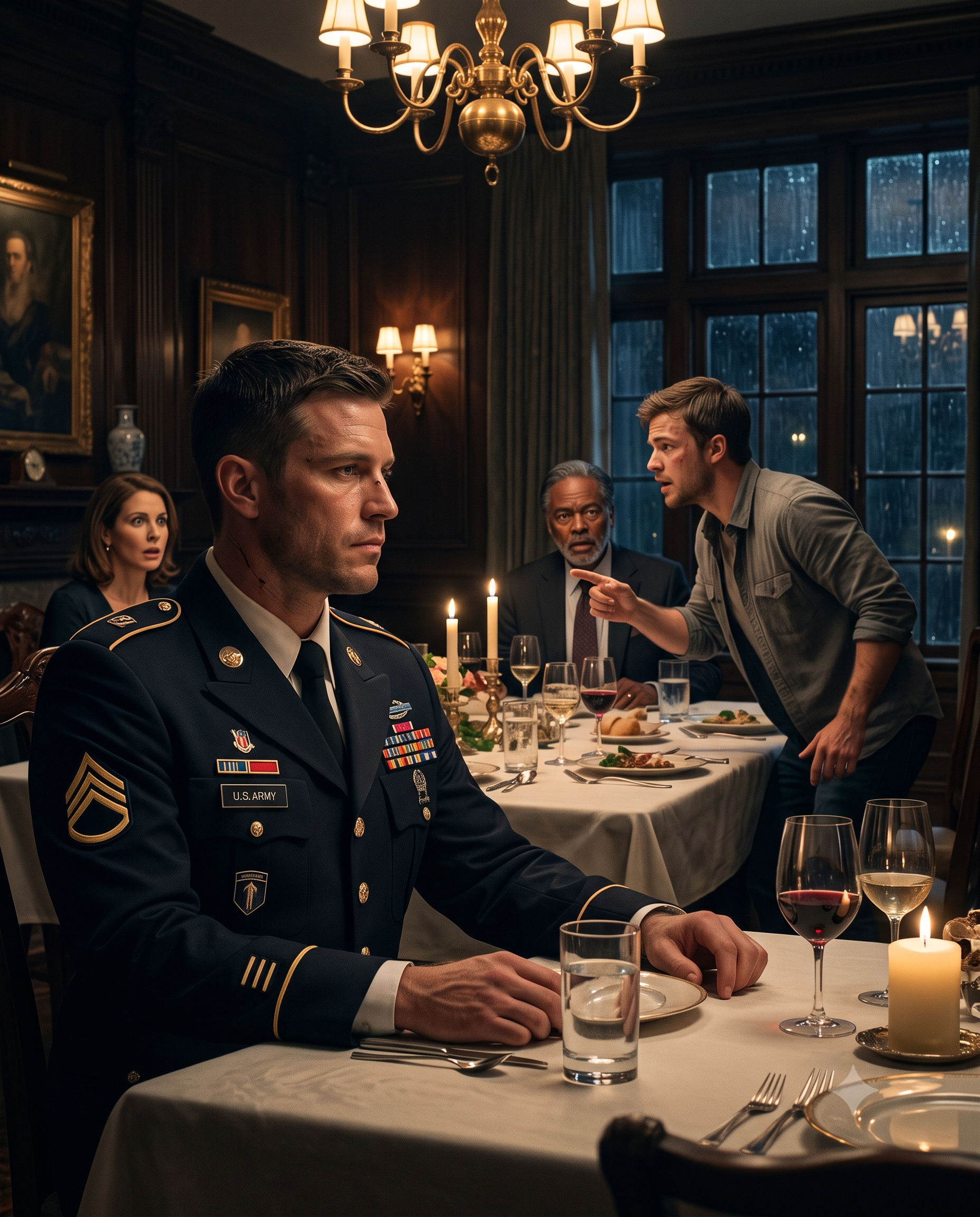
Chapter 2
I had tried.
I had tried because I loved my wife.
I had tried because I knew families could be complicated.
And I had tried because I had spent enough time in the Army to understand that not every insult deserved a response.
But sitting at that table, I realized something had changed.
I was no longer angry about what Richard thought of me.
I was disappointed that Caroline had spent seven years teaching him he could say anything he wanted without consequence.
Richard lifted his glass.
“To family,” he announced.
Everyone raised a glass.
I lifted mine, too.
Then he looked at me and added, “And to finally convincing Michael to aim a little higher.”
A few people laughed.
I took one sip of water and put the glass down.
“Thank you for dinner,” I said.
Caroline looked up sharply.
“Michael?”
“I have an early morning.”
“You just got here.”
“I know.”
I stood, thanked Patricia for the meal, and walked toward the front door.
Caroline followed me into the hallway.
“What are you doing?” she whispered.
“Going home.”
“Please don't make this into a scene.”
I looked at her.
“Your father made the scene. I'm simply leaving it.”
She folded her arms.
“He was trying to motivate you.”
“I'm a staff sergeant in the United States Army, Caroline. I lead soldiers, train people, and carry responsibilities your father has never had to understand. I don't need him to motivate me.”
“Then why do you let him get to you?”
That question almost made me laugh.
I had spent years refusing to react because I didn't want to create problems for her.
Somehow, my silence had convinced her that nothing was wrong.
“I'm not letting him get to me,” I said. “I'm deciding how much longer I'm willing to sit at a table where my wife won't defend me.”
She looked as though I had slapped her.
“That's unfair.”
“Maybe.”
I opened the door.
She didn't follow me outside.
I drove home beneath a dark Tennessee sky, my uniform jacket hanging on the passenger seat.
I thought about the men I had served with, the lives we had protected, and the promises we had made to one another when things became dangerous.
Then I thought about Richard Lawson calling me a nobody.
I had heard worse words from people who wanted me dead.
But somehow, his contempt hurt in a way enemy fire never had.