
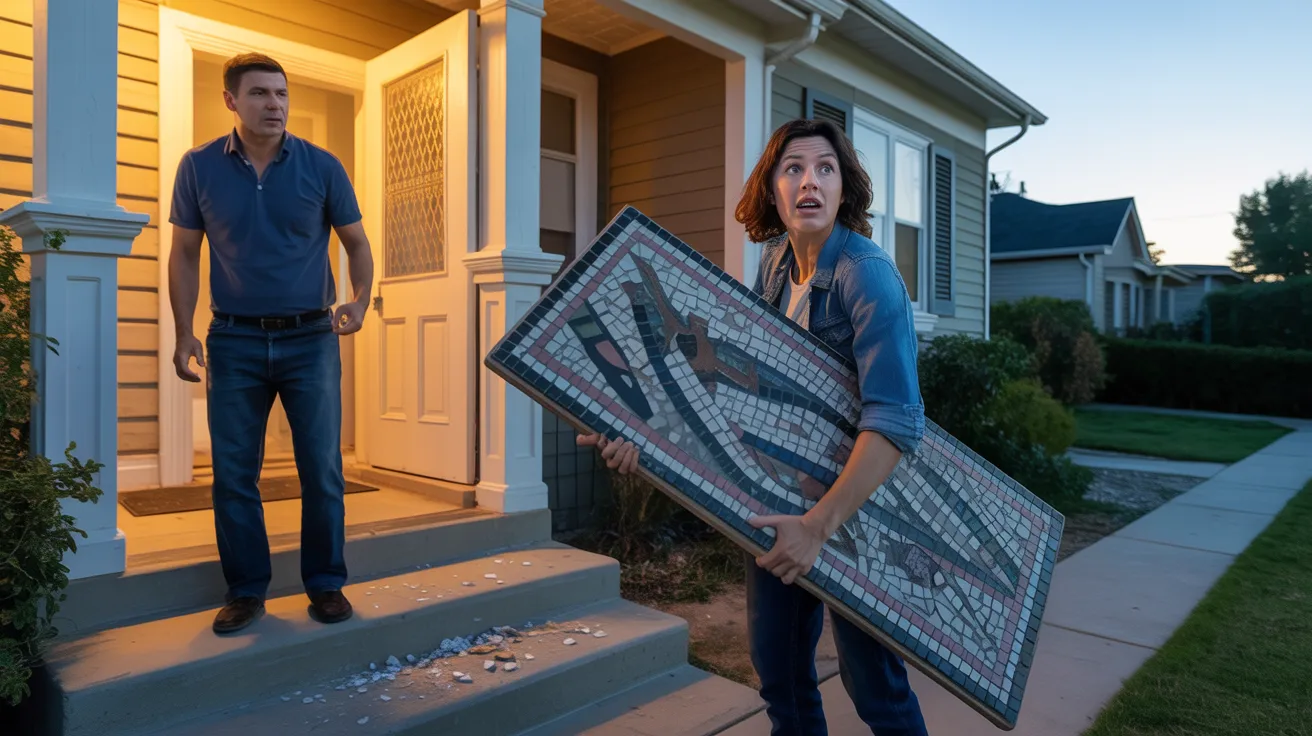
Man Refuses To Lend His Art To His Neighbor, But She Breaks Into His House And Takes It Anyway

Chapter 1

THEME:
FONT SIZE: 18px

Boundaries around personal property can get blurred when people don’t respect your time and effort. That’s what one artist faced when his neighbor, Claire, asked to borrow his intricate mosaic for her dinner party.

Despite the fact that the artwork wasn’t just a decoration but a personal, irreplaceable piece he’d worked on for months, Claire continued to push for it, even accusing him of being “stingy” when he refused.

Things took a shocking turn when the man came home to find his front door slightly open and the mosaic missing.

Man Refuses To Lend His Art To His Neighbor, But She Breaks Into His House And Takes It Anyway
Not the actual photo

'AITA for refusing to let my neighbor “borrow” my mosaic for her dinner party?'

I (38M) make mosaics as both my job and my art. I’ve spent the last year working on a kitchen-themed piece that’s part of a personal series.

It’s about six feet long, took hundreds of hours, and is kind of my “baby” right now.

It’s not for sale yet — I’m planning to show it in a gallery later this year.

My neighbor “Claire” (40sF) came over last week and saw it in my studio.

She immediately started gushing over it and said it would “match her dining room perfectly.”

I thought she meant in a “wow, I love this” kind of way, so I said thanks.

Then she asked if she could borrow it for her dinner party this weekend.

She said it would be “such a conversation piece” and “everyone would totally tag me on Instagram,” so it would be “free advertising” for me.

I said no, it’s fragile, irreplaceable, and honestly, I don’t loan out my art like it’s a casserole dish.

She got offended and said I was being “stingy” and “k__ling the vibe of the community.”

She told me she’d be super careful and even promised not to “spill wine on it” (???)

I told her again that it’s not happening. Now she’s been cold-shouldering me whenever I see her.

Another neighbor mentioned she complained about me being “selfish” over “just some tiles.”

So… AITA for refusing to loan out my mosaic.

UPDATE: Neighbor drama over my mosaic got weird. So, I didn’t think this would escalate, but… it did.

The dinner party night came and went. I didn’t hear any loud music or see any guests, so I assumed maybe she’d moved on. Nope.

Two days later, I come home from running errands and notice my front door is slightly open.

My stomach dropped. I go inside… and my mosaic is gone.

I look around and see tiny bits of grout on the floor, like she’d tried to move it in a hurry.

I walk over to her house, knock, and sure enough, there it is. My mosaic.

Propped up on a buffet table. Still with little bits of brie and cracker crumbs on it.

I asked her what the hell she was doing, and she just went, “Oh, relax, I was going to bring it back tomorrow. You weren’t even using it.”

I told her I was calling the police if she didn’t give it back immediately.

She rolled her eyes, carried it over like it was a laundry basket, and said I was “dramatic.”

Now, a couple of neighbors think I’m “overreacting” because “no harm was done,” but I’m honestly still floored that she just… broke into my house to steal my art for...

So yeah. Guess I went from NTA to calling a locksmith.

At first glance, this conflict over a mosaic might sound like an awkward neighbor dispute, but it actually cuts to the heart of two core human needs: personal boundaries and respect for ownership.

What happened here is more than social awkwardness; it reflects how deeply people value control over their own creations and the emotional harm that results when others ignore that boundary.

The OP’s mosaic wasn’t just an object, it was the culmination of hundreds of hours of work, creative intention, and artistic identity.

Artists often feel a profound sense of ownership and connection to their work that goes beyond mere physical possession.

While legal definitions of ownership differ from moral ones, scholars have long discussed the concept of moral rights in art, the idea that even after an artwork is sold or transferred, it retains a connection to the artist’s intent and integrity.

In some legal systems, these rights include the ability to control how a work is used or modified, precisely because the meaning attached to the object matters.

Although American law does not always grant these rights formally, the psychological and cultural importance of an artist’s control over their work is well documented.

Refusing to lend the mosaic was not only a practical decision (fragile, unreplacable, and intended for an upcoming gallery showing), it was an assertion of personal boundaries.

Personal boundaries are internal limits that define where one person ends and another begins, emotionally, physically, and materially. These boundaries help individuals protect their autonomy, values, and mental well‑being.

Setting and enforcing boundaries is not selfish in itself; it’s a life skill that defines what one will and will not allow others to do with their space, possessions, or emotional energy.

The neighbor’s initial request already demonstrated a lack of respect for those boundaries. Borrowing a casserole dish and borrowing a painstaking, gallery‑worthy mosaic are not equivalent.

← PREV | NEXT →
Table of Contents
Man Refuses To Lend His Art To His Neighbor, But She Breaks Into His House And Takes It Anyway
TABLE OF CONTENTS 3